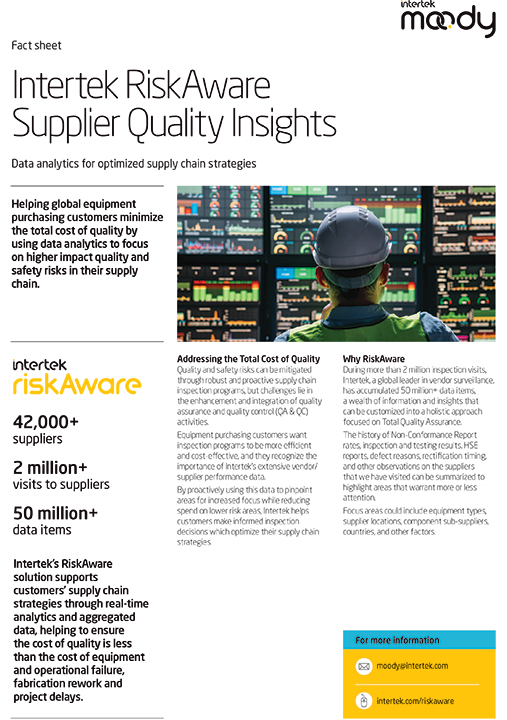
Intertek RiskAware: Helping global equipment purchasing customers optimize their supply chain strategies by using data analytics to focus on the higher impact quality and safety risks.
More than 50 million quality data points, gathered by Intertek experts during vendor inspection visits around the world, create a unique and powerful database called Intertek RiskAware. Our technical specialists have captured these vital quality insights at over 44,000 suppliers in more than 100 countries on behalf of more than 1,000 customers.
The NCR’s (non-conformance report) and quality-related observations made during the more than 2 million inspection visits have been aggregated to give Intertek market-leading intelligence relating to supplier performance. Utilizing this data, Intertek helps customers make the most of their quality budgets by pinpointing areas that indicate higher quality or safety risks.
What does this data reveal?
Since 2010, Intertek has recorded an NCR (Non-Conformance Report) during approximately 1.44% of the over 2 million inspection visits we have conducted globally, and they have been captured across all types of manufactured equipment. The NCRs typically required a stoppage in the manufacturing process and required a level of engineering disposition and correction to continue fabrication. In recent years, Intertek has also started tracking all quality observations made by inspectors during the inspection process. Often these observations do not turn into NCR’s, but they do require some level of corrective action. Categorizing these quality observations into Highly Critical & Low Generic observations, we have found that 3% of inspection visits contain highly critical observations requiring client intervention, while 40% of our inspectors' visit observations require supplier correction.
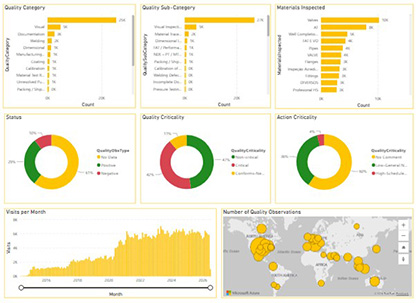
Quality Observations
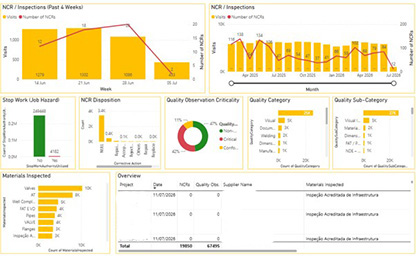
Quality Overview
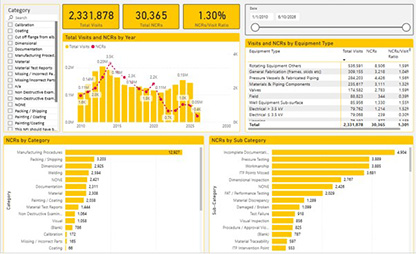
NCRs by Category
Do NCR rates change based on commodity?
Intertek has found that NCR rates can range dramatically based on the commodities being manufactured. For example, electrical components and rotating equipment tend to have an NCR rate of approximately 2% while static equipment like pressure vessels, piping, and valves are slightly above the global average at 1.6%. The highest NCR rates tend to be on OCTG (oil country tubular goods) and subsea components at well over a 2% NCR rate, the highest of which are umbilicals and flexibles at nearly 3%. The lowest NCR rates, at approximately 1%, tend to be found on general fabrication such as frames, skids, etc.
What are the most common reasons for issuing NCRs?
The most common reason NCR’s are issued is due to incomplete documentation upon completion of an order. This makes up approximately 16% of all NCRs issued. The next three most common issues are not properly following test procedures, overall poor workmanship, and missed ITP (inspection test plan) points. Each of these non-conformances make up 14% of all NCRs respectively. Dimensional issues and failed performance tests are each noted on 10% of non-conformances. The remaining NCRs include unapproved procedures, material traceability, tagging/nameplate, drawing design, coatings, packing/shipping, etc.
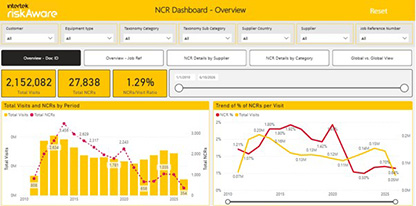
NCR Dashboard - Overview
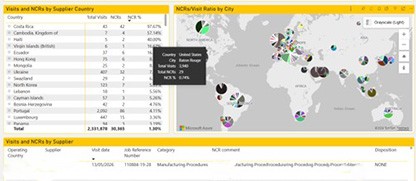
NCRs by Supplier Country
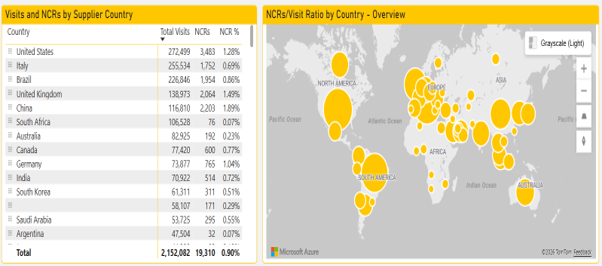
NCR/Visit Ratio by Country
Do NCR rates change based on the origin of country?
Yes, and this seems to be where we see the largest fluctuation in NCR rates. Additional details can be provided upon request.
Does Intertek gather supplier-specific data?
Yes, Intertek also possesses supplier specific NCR data on over 44,000 equipment suppliers globally. This data can change significantly based on individual locations of a supplier and the commodity being sourced. Intertek uses this data internally to customize the inspection plans of our clients based on the suppliers being utilized and the criticality of the orders being placed. Our proprietary knowledge of the most common issues at a particular supplier allows us to better prepare our inspection team for the most expected issues.